
Santiago Borja ’s Journey at Abbey Road Institute Miami “I Like Feeling Uncomfortable”
From recording drums with a Guitar Hero microphone to earning a Latin Grammy medal as part of a nominated Album of the Year project, Santiago Borja’s career has been defined by curiosity, persistence, and a willingness to embrace new challenges.
And what happens when someone who already owns a studio, has years of experience, and has built a successful career in their home country decides to start over in a completely new environment?
That was exactly the situation for Santiago Borja when he left Quito, Ecuador, and moved to Miami to study and join the Advanced Diploma in Music Production and Sound Engineering at Abbey Road Institute Miami.
During a remote interview, we spoke with Santiago about his journey into music production and sound engineering, the challenges of stepping into a larger music industry market, and how mentorship and hands-on experience helped shape his career.
What became immediately clear throughout the conversation was that Santiago has always been driven by curiosity. Whether it was recording drums with improvised equipment as a teenager or later building playback systems for Grammy-winning artists, his mindset has always been the same:
figure things out, keep learning, and keep moving forward.
Recording Drums With a Guitar Hero Microphone
Long before professional studios, major artists, and Miami sessions entered the picture, Santiago was simply a teenager obsessed with music.
Growing up in Quito, Ecuador, he started playing drums at around 13 years old. But performing wasn’t enough. He also became fascinated by the process happening behind the scenes.
During the interview, we asked him when he first realised he wanted to work in music production and engineering.
“I always liked telling everybody what to do musically,” he says, laughing. “I think that naturally pushed me toward production.”
At the same time, he was deeply interested in technical subjects.
“I loved physics and math in school. My brain has always worked that way.”
That combination, creativity mixed with technical curiosity, became the foundation of his future career.
Before he had access to professional equipment, Santiago started experimenting with recording using whatever he could find at home. One of his earliest setups involved hanging a USB Guitar Hero microphone from the ceiling to use as a drum overhead mic.
It was improvised. Imperfect. Probably noisy.
But it worked.
And more importantly, it taught him something that would define much of his later success: limitations can force creativity.
“I’ve always been the kind of person that asks: okay… how do I make this work?”
(The interview continues below the image)
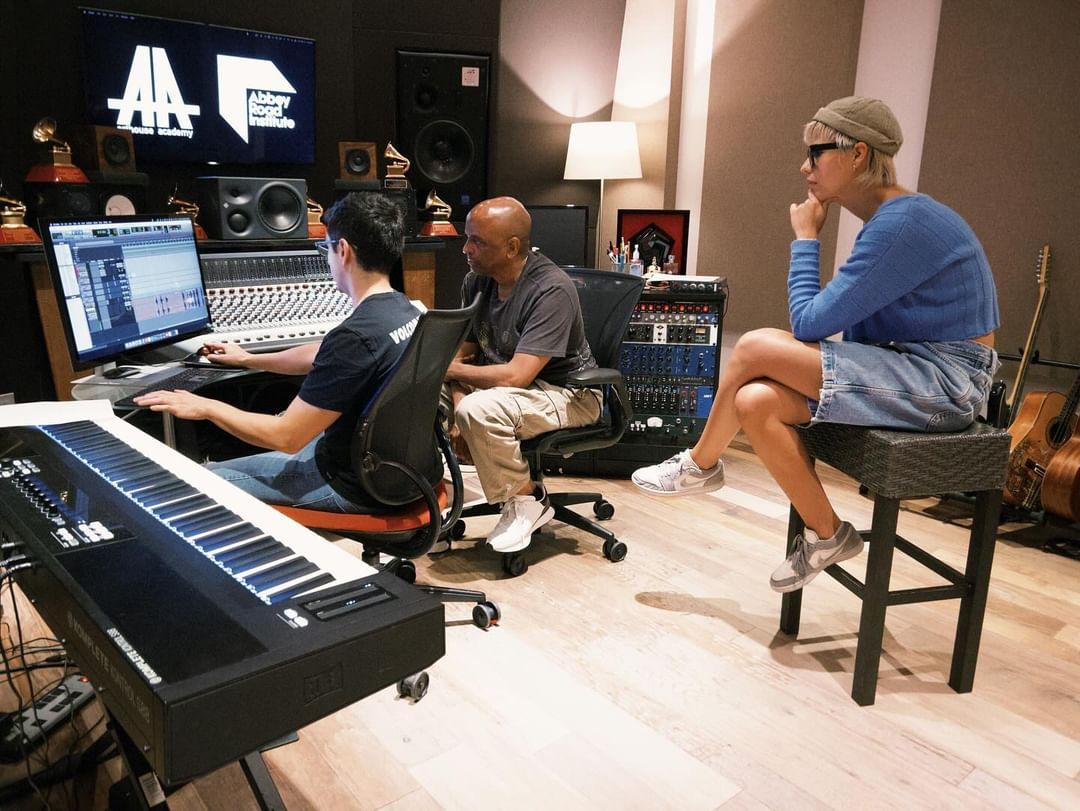
Santiago Borja, Sergio George in the studio for Annasofia recording
Building a Career in Ecuador
Over the years, Santiago transformed that curiosity into a professional path. Before arriving in Miami, he had already spent more than a decade running his own studio in Ecuador, called “Loop Studio”.
At the same time, he studied music production and engineering, completed an MBA in Business Administration, and even managed his family’s company for a period of time.
By most standards, he had already built a stable and successful career.
His studio became especially known for recording drums, something he had become highly specialised in through years of experimentation with acoustics and room treatment.
“Everybody wanted to record drums there,” he explains. “I spent a lot of time understanding how the room should sound.”
Artists from outside Ecuador even began travelling to work with him. But despite the success, Santiago started feeling something many creative professionals eventually experience: comfort. And comfort, for him, became dangerous.
“The music industry in Ecuador is small,” he says. “After a while, I felt like I needed a bigger challenge.”
That realisation eventually led him toward Miami.
Discovering Abbey Road Institute Miami
Santiago had already known about Abbey Road Institute for years before making the move. Initially, he was familiar with the London campus, but during the pandemic, he attended an online webinar featuring Julio Reyes Copello.
That moment changed everything.
“The way they talked about the program felt very connected to the real industry.”
Unlike traditional education environments that can sometimes feel disconnected from professional practice, Santiago immediately sensed something different about Abbey Road Institute Miami.
“At Abbey Road Institute Miami, the gap between studying and actually working in the industry feels much smaller.”
That was exactly what he was looking for.
Not theory alone. Not just software tutorials. Not only classroom learning.
He wanted proximity to the real world.
Santiago Borja Starting Again in Miami
Moving from Ecuador to Miami meant stepping into a completely different ecosystem.
New people. New expectations. New pace.
A much larger industry.
And despite already having years of experience, Santiago suddenly found himself back in the position of a student.
But instead of seeing that as a setback, he embraced it.
During our interview, Santiago repeatedly returned to the idea of challenge and discomfort. In many ways, that mindset became the emotional core of his entire story.
“I like feeling uncomfortable,” he says. “That’s when I know I’m growing.”
Although Santiago already had years of studio experience before entering the Advanced Diploma in Music Production and Sound Engineering, he quickly realised the program offered something far beyond a technical curriculum alone.
Under the mentorship of Robin Reumers and the wider Miami team, Santiago found himself learning directly from professionals actively working in high-level music industry environments every single day.
“You can learn technical things online,” he explains. “But being able to ask questions directly to people who are doing this professionally every day… that changes everything.”
That access became one of the defining aspects of his experience.
(The interview continues below the image)

Santiago Borja, in his studio “Loop Studio” in Quito, Ecuador
Learning Beyond the Classroom
One of the most interesting parts of Santiago’s story is that many of the biggest lessons he describes are not necessarily technical.
Again and again during the interview, he spoke about:
- communication,
- artist psychology,
- adapting under pressure,
- reading the room,
- and understanding people.
In professional sessions, technical ability alone is rarely enough.
“You have to understand the human side too.”
That perspective became especially important as he started working on larger sessions in Miami.
Within a relatively short time after arriving, Santiago was already assisting on projects involving internationally recognised artists. He immersed himself completely in the environment, observing workflows, studying engineers, asking questions, and paying close attention to how experienced professionals handled pressure.
Rather than simply trying to “finish school,” he treated every session as a learning opportunity.
“Take advantage of the people around you. That’s the most valuable thing.”
One thing Santiago noticed quickly was that growth often depended on initiative.
Students who stayed curious, asked questions, and actively built relationships tended to progress much faster than those waiting passively for opportunities to arrive.
That mindset became one of his biggest strengths.
Working With Major Artists
Today, Santiago works across recording, engineering, playback engineering, live production, and technical studio operations at Miami Art House.
His credits include work with artists such as Marc Anthony, Camilo, Natalia Lafourcade, Bad Bunny, and Lauri Ylönen.
But despite the impressive credits, Santiago speaks less about celebrity and more about responsibility.
Sessions move fast. Expectations are high. Technical issues need immediate solutions.
“You have to be prepared for everything.”
One of the standout experiences in his career so far has been his work with fellow Abbey Road Institute Miami graduate Joaquina.
Santiago contributed to vocal recording sessions for Joaquina’s Grammy-winning project and later became involved in her live touring setup through playback engineering, Ableton programming, and show arrangements.
During the interview, he described how those experiences constantly challenged him. Not only technically, but personally.
“Every session was different. You need to solve problems quickly, but you also need to make sure the artist feels comfortable and supported.”
His work on Joaquina’s music also led to an important career milestone. Joaquina’s album Al romper la burbuja was nominated at the 2025 Latin Grammy Awards for both Album of the Year and Best Pop Vocal Album.
Santiago worked on the project as a Recording Engineer, earning his first Latin Grammy medal and diploma as part of the nominated team.
“That was a really special moment,” he reflects. “The album was nominated alongside incredible projects. We were competing against Bad Bunny, who ended up winning that category, but receiving the medal and diploma was a huge milestone for me.”
The recognition followed another major project in 2024, when Santiago worked as an Assistant Engineer on a project with Camilo, further expanding his experience at the highest levels of the Latin music industry.
(The interview continues below the image)

Santiago Borja Grammy Nomination Medal
Moving Toward Music Production
One thing that became increasingly clear throughout the interview was that Santiago’s ambitions go far beyond technical execution alone.
Although he has become highly respected for his engineering abilities and problem-solving mindset, his long-term vision is centred around producing artists and helping shape music creatively from the ground up.
“I don’t want to only engineer,” he explains. “I love the combination of music, technical knowledge, and the business side.”
That balance between creativity and technical precision has become one of the defining themes in his career.
Today, alongside his engineering and playback work, Santiago is already producing music for developing artists. Helping them not only shape their sound, but also think about identity, direction, and long-term growth.
His background in engineering allows him to communicate ideas fluently inside the studio, while his MBA and entrepreneurial experience help him understand the broader realities of artist development and the music business.
For Santiago, producing is not just about making songs.
It’s about understanding people.
“Every artist is different,” he says. “You have to understand how to communicate with them, how to make them comfortable, and how to help them bring out the best version of themselves.”
In many ways, that human-centred mindset connects everything he does, from recording sessions to live playback engineering to production.
And as his career continues to evolve in Miami, production increasingly feels like the direction that’s pulling everything together.
“That’s When I Know I’m Moving Forward”
Toward the end of our conversation, we asked Santiago for advice for future students considering a music production or sound engineering course.
His answer reflected the exact philosophy that brought him from Ecuador to Miami in the first place.
“You have to challenge yourself,” he says. “If everything feels comfortable, maybe you’re not growing anymore.”
It’s a mindset that continues to guide him today.
Even after building a strong career foundation in Miami’s music industry, Santiago is already searching for the next challenge, the next uncomfortable situation that might force him to evolve again.
And perhaps that is what makes his story resonate so strongly.
Not just the achievements. Not just the artist credits. Not even the technical skill.
But the willingness to remain curious enough to keep growing.
Interested in a Career in Music Production?
Whether you’re an aspiring producer, engineer, or artist, the Advanced Diploma in Music Production and Sound Engineering at Abbey Road Institute Miami offers hands-on music production education built around mentorship, real-world industry experience, and professional studio training.
Learn more about the music production school that Miami students like Santiago chose to accelerate their careers: Abbey Road Institute Miami Campus
Blog: Joaquina Blavia takes her music to new heights
Learn more about Santiago Borja: official website
